Saturday, November 24, 2012

China's challenge with corruption


Beijing
Just two years after he founded Communist China, in December 1951, Mao Zedong issued one of his characteristically forthright directives. "We must probably execute 10,000 to tens of thousands of these embezzlers before we solve the problem," he wrote.
The “problem” was corruption, and 60 years later it has not gone away. As he takes the reins, the newest leader of China’s ruling Communist Party, Xi Jinping, is himself making the issue his number one talking point.
Corruption – perhaps the ordinary Chinese citizen’s single biggest complaint against his rulers – “will inevitably doom the party and the state” unless it is curbed, Mr. Xi warned the first meeting of the newly chosen 25 member Politburo last weekend. “All behavior that violates party discipline or the law should be punished without mercy.”
Turning that talk into action, however, will be a tall order in a country where gift-giving is a pillar of traditional culture, a single political party has a stranglehold on power, and bribery is pervasive from top to bottom of society. Some 668,000 party members have been punished for corruption in the past five years, according to official figures that represent only the tip of the iceberg, experts say.
“Controlling corruption will be a huge challenge for any regime,” says Lu Xiaobo, a professor at Barnard, Columbia, who has written a book about official corruption in China. “Realizing that it’s a problem and making it a priority does not necessarily mean they will be successful” in fighting it.
Reason for hope?
China’s citizenry could be forgiven for being skeptical. Their leaders have been decrying corruption – and doing very little about it – for decades. But some corruption experts here say there may be reason for a little more hope this time.

At least 18 dead in China coal mine explosion


Eighteen people were killed and five others are still trapped after an explosion Saturday at a coal mine in the southern Chinese province of Guizhou, state-run media reported.
The accident occurred around 11:00 a.m. at the Xiangshui coal mine in the town of Liupanshui.
Emergency personnel have rescued five miners and were working to pull out the other five who remain trapped.
Chinese coal mines are the most dangerous in the world, with around 3,000 deaths occurring annually due to lack of safety measures and cave-ins caused by overexploitation.
Coal supplies between 60 percent and 70 percent of the energy needs of the world's second-largest economy.

Posted by: Shawn Huyck 

Sunday, November 18, 2012

Japan, North Korea begin new talks in Mongolia; Tokyo seeks details on decades-old abductions


TOKYO — Japan and North Korea began talks Thursday in Mongolia that Tokyo hopes will shed light on decades-old abductions.
The meetings in the Mongolian capital of Ulan Bator are scheduled to last through Friday. In August, lower-level negotiators from Japan and North Korea held the countries’ first bilateral talks in four years, but made little progress.
Japan wants information on the abductions of Japanese citizens by North Korean agents in the 1970s and ‘80s. Japan believes at least one abductee may still be alive in the North, though North Korea denies this. Five abductees were returned to Japan in 2002.
Japan and North Korea do not have formal diplomatic relations. The abduction issue and concerns over North Korea’s nuclear and missile programs have long strained ties.
Japanese officials indicated before the start of the talks that they expected them to be tough and not likely to lead to any immediate breakthroughs. North Korea’s official media provided few details, reporting only that they were intended to deal with issues of mutual interest.
Japan has imposed strict sanctions against the North and cut off most economic and cultural exchanges in 2006 after a missile launch. Tensions heightened again earlier this year when the North launched a rocket that it said carried a satellite, but that Japan and other countries criticized as a thinly disguised test of long-range missile technology. The launch failed just after takeoff.

Posted by: Shawn Huyck 

US must clearly back Japan in islands dispute with China


The United States might prefer that the territorial dispute between China and Japan over uninhabited islands simply go away. America, after all, has enough of its own problems to fix. And it’s loathe to meddle in a fight between two of its most important trading partners – countries still grappling with their war-time history.

While the recent flare-ups over their rival claims to islands in the East China Sea may temporarily die down, the underlying causes will not be resolved anytime soon. The dispute also has the potential to escalate into a tempest that threatens the region – and in turn, America’s security.
America rightly wants good relations with both Japan and China. However, sometimes one has to take sides. Intentional ambiguity can be useful in foreign affairs, but not here.
The US, then, should take this moment to ensure its position avoids any ambiguity toward the islands, called Senkaku in Japan and Diaoyu in China. It should stand far more publicly with its democratic ally, Japan, and against the bullying tactics being applied by China. Asian countries are closely watching.
True, Japan has ongoing territorial disputes with South Korea and Russia. But Japan has not used or threatened force, or applied economic pressure to retrieve what it considers Japanese territory.
Chinese behavior in the last two years starkly differs. Chinese patrol boats continue a cat-and-mouse game of harassment near the Senkakus. Beijing has encouraged and apparently fomented rioting against Japanese interests in China. And it has threatened and carried out economic retaliation against Japan. Chinese officials and media have made crudely aggressive and derogatory statements toward Japan and Japanese people.

Japanese economy contracts; economists, officials predict a recession


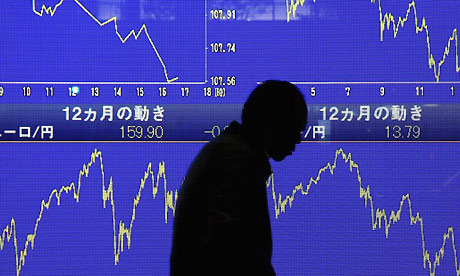
TOKYO — Japan’s economy contracted 0.9 percent in the late summer, according to government data released Monday, as officials and economists here warned that the country appears headed toward a recession.
At an annualized rate, Japan’s gross domestic product shrank 3.5 percent, a reversal after two quarters of growth. The drop-off signals the major obstacles facing the world’s third-largest economy as it deals with weakened demand in Europe and a simmering diplomatic spat with China, both of which have hurt Japanese exports.
Japan’s exports for the quarter — a period between July and September — plummeted 5 percent, the steepest drop since immediately after the March 2011 earthquake and tsunami.
“In part, this may have been due to the anti-Japan demonstrations in China and the subsequent boycott of Japanese goods,” Barclays Economics Research wrote in a note after the data were released.
Economists predict that Japan’s economy will shrink again in the next quarter, leading to a technical recession. If Japan goes into recession, it would be its third since 2008, according to Bloomberg News.
“Judging from recent economic indicators, the possibility cannot be ruled out that the Japanese economy is already in a recessionary phase,” Seiji Maehara, Japan’s minister of state for economic and fiscal policy, told reporters.
A potential but modest recovery in 2013 could come if the world’s biggest economies — the United States and China — continue to rebound. “Going forward, developments in Japan’s economy will basically depend on those in overseas economies,” said Masaaki Shirakawa, the governor of Japan’s central bank.

Both U.S. and China Will Appoint New Trade Negotiators


BEIJING — The rare congruence of the U.S. and Chinese political calendars this month, with both countries choosing leaders for the coming years, is about to produce an equally rare replacement of most of each side’s senior trade negotiators, with unpredictable results for bilateral economic relations.
One of the few surprises in the carefully scripted party congress that ended Wednesday was that Commerce Minister Chen Deming lost his seat when delegates chose the members of the Communist Party’s Central Committee for the next five years.
Under party rules, that means he will have to step down as minister at the National People’s Congress next spring. His loss of membership in the Central Committee also meant that he was ineligible to join the Politburo last Thursday and become one of the four vice prime ministers, as some analysts had expected.
Some Chinese analysts say that the broad direction of the country’s international economic policy is clear and consistent and that changes of individuals will not make much of a difference.
“The fundamental policy on international trade is adherence to opening and reform,” said He Weiwen, co-director of the China-U.S.-E.U. Study Center at the China Association of International Trade in Beijing. “It will certainly continue and develop to a new height, including China’s trade policy on the U.S.”
But the significance of Mr. Chen’s departure from the Central Committee has produced a divided reaction among Western experts on China’s policymaking process on international economics. He had a reputation within China for being a gentlemanly figure who chooses his words with care and has not indulged in outspoken denunciations of the West during trade disputes, even as the tone of social media in China has become increasingly nationalistic on economic policy.

China's future leaders face long march to power


Analysts say the front runners for 2022 are Hu Chunhua, a literature graduate who cracked down on protestors in Tibet, and Sun Zhengcai, who spent time as an agricultural researcher in the British countryside.
The two men, both 49, were named to the all-powerful 25-strong Politburo, the nation's second most powerful committee, after last week's pivotal Communist Party congress.
Many believe they are now headed for the inner circle of Chinese politics, the seven-member Politburo Standing Committee which Mr Xi is expected to lead for the next decade.
Mr Xi's own ascension had been expected since 2007, when he was given a position on the standing committee.
Aside from Mr Xi and number-two Li Keqiang, its other members will have to step aside at the next congress in 2017 after they reach retirement age, clearing the way for the next generation to step up.
At the same time Mr Hu and Mr Sun's Politburo colleagues are all significantly older, meaning many will be out of the running for the highest posts in 2022.
"There is a big possibility that both will become China's top leaders in 10 years time as they are the youngest on the Politburo," said Zhang Xin, a political scientist at People's University in Beijing.
"They are in good position for advancement, but they still have to prove themselves in the coming years."
China's choreographed Communist successions are a start contrast to the boisterous elections of Western democracies, and critics say they are out of place in a fast-modernising society with aspirations for greater transparency.